


Why your Safety File may not be enough when an Insurance Claim is investigated
A safety file proves you knew the rules. It doesn't prove you followed them. Here's what inspectors and insurers actually check after an incident.
For hotels, Lodges, Guesthouses and Game Reserves in South Africa
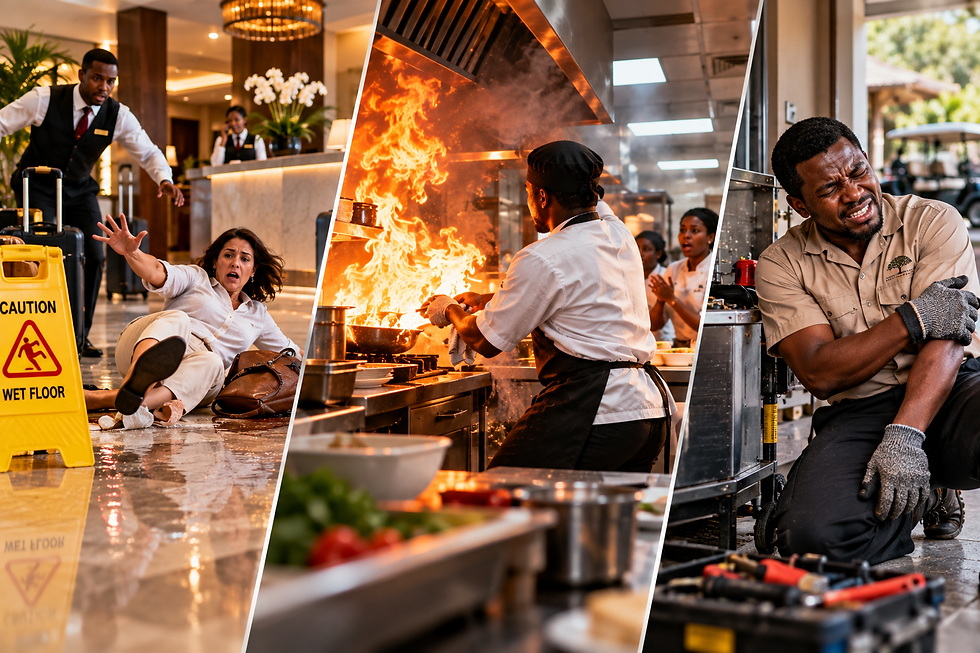
A guest slips in a wet lobby.
A kitchen fire spreads faster than anyone expected.
A staff member is injured operating equipment during a busy weekend.
When something goes wrong at a hospitality property, two (2) things happen almost immediately: The department of Employment and Labour may come to inspect, and your insurer will come to ask questions!
Most properties are ready for the first. Far fewer are ready for the second.
This isn't hypothetical
In September 2024, the Department of Employment and Labour inspected, across all nine provinces. Only 51% were found compliant - in Gauteng, compliance was as low as 28%. The same campaign recovered more than R10 million in penalties owed to hospitality employees by non-compliant employers.
The pattern hasn't gone away. In February 2026 follow-up sweep, inspectors found businesses across five sectors - hospitality among them - non-compliant with OHS Act at rate of 73%.
The violations named were the ordinary, avoidable kind:
risk assessments never produced,
no trained first aiders on site,
no PPE issued,
electrical installations without certification.
None of this is a rare event happening to someone elses business. It's the documented result of inspectors actually showing up. And ignoring it carries a real cost: The Act gives an inspector the power to stop an unsafe activity on the spot, and the R10 million already recovered is money businesses lost, not a warning they were given.
Does having a safety file protect a business after an incident?
A safety file shows that business knew what was required. On it's own, it doesn't show that the system was actually being followed - which is what an insurer or inspector checks once an incident has already happened.
It's the record of the system, and only counts as proof if the record matches what was actually done.
THE CLAIM THAT GETS TESTED.
When a claim is investigated after an incident, the question is not "did this business have a safety file?" It's " was this business actually following it?"
That distinction decides more outcomes than a missing document ever could. An insurer looking at a claim after a guest or staff injury doesn't stop at the cover page. They look for evidence of a working system: current risk assessments, signed appointments that were genuinely acted on, training records with named employees, incident logs, committee meeting minutes, maintenance and monitoring records. A safety file that was built once - at opening or in a rush before an inspection - and never touched again reads as exactly what it is: a document, not a system.
Under South African's Occupational Health and Safety Act the chief executive officer of a business carries the ultimate legal responsibility for OHS compliance. This can be assigned to a manager for day-to-day handling, but the accountability doesn't transfer with it - the person at the top remains legally exposed, no matter who was assigned the task.
That's also why the Act gives inspectors real reach.
Section 29 allows an inspector, without previous notice, to enter a workplace, question anyone on the premises, require the production of records, and inspect the actual conditions, equipment and work being performed. An inpsector isn't limited to checking whether a folder exists - they can ask any staff member whether they know their role, whether a risk assessment was reasonably acted on, whether an appointment was more than a signature.
The same standard applies, in practice, to how an insurer investigates a claim.
A folder proves you knew what was required.
It doesn't prove you did it.
What changes when it's structured.
The properties that come through an inspection - or a genuine emergency - without a crisis are the ones where compliance was built as an ongoing system, not a once-off document. That's the difference between a safety file and governance process:

When compliance is run this way, an inspection stops being a moment of anxiety, and a claim after an incident stops being a gamble. They system speaks for itself, because it was never just paperwork to begin with - it was a business genuinely prepared for the day something goes wrong.
THE REAL TEST
No safety file, however well organised, will put out a fire, calm a guest or safely evacuate a building.
What does that is t a team that has actually rehearsed what to do, because the systems behind the paperwork were implemented, not just written. That's the outcome a safety file is supposed to produce - and the one, an insurer, and an inspector, will actually look for.
Book a call with our leading expert, Robin Tapinos today.
RITE builds OHS systems for South African hospitality businesses that hold up under inspection and under scrutiny - audited, documented, implemented, and maintained monthly.


Comments