


OHS Compliance in South Africa:
Stop Memorising Safety. Start Understanding It
Let’s start with a scene you probably know.
It’s a Tuesday morning.
You get the message:
“Department of Labour inspection expected.”

Suddenly:
Files come out
People start asking questions they should already know
Someone prints documents like ink is free
And for a brief moment…your business becomes very compliant.
The Problem Isn’t Compliance. It’s Reality.
I walked into a logistics warehouse in Gauteng recently. About 40 staff. Fast-moving environment. Tight deadlines and the operations manager said:
“We’re sorted. Everything is in place.”
So I asked:“Show me how your safety system works at 10:30 on a busy day.”
Not during a meeting. Not during an audit. When things are messy.
What We Found
Within 15 minutes:
Forklift routes overlapping pedestrian walkways
PPE being worn… incorrectly
Supervisor unsure of escalation process
Near-miss from the previous day not reported
If inspection happened that day - They would have failed on:
Risk control implementation
Incident reporting
Supervisor competency

Not because they didn’t have documents. Because the system didn’t live in the business.
The Real Breakdown
1. HIRA Was Filed… Not Used
The HIRA was detailed. Signed. Dated.
But when we asked:
“What’s your biggest risk right now?”
No one could answer clearly.
👉 HIRA is not a document. It’s how you think.
If your team can’t identify risk in real time,your HIRA is irrelevant.
2. SHE Committee Was Busy… Not Effective
They met monthly.
They recorded everything.
They solved nothing.
Issues were discussed. Then carried over.Then forgotten.
👉 Your SHE committee isn’t broken. It’s confused.
It thinks its job is to talk.
Its job is to drive decisions and accountability.
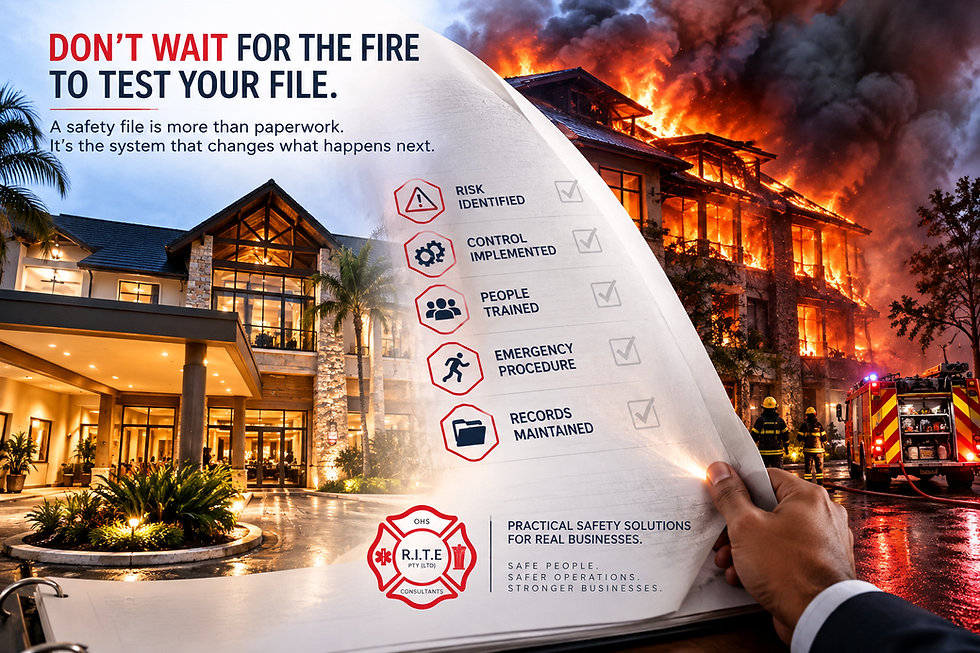
3. Safety File Was Complete… But Useless Under Pressure
Everything was there.
But on the floor:
People guessed
People escalated late
People relied on “common sense”
👉 Your safety file isn’t incomplete. It’s disconnected from your team.
And under pressure, disconnected systems fail first.
Why Most OHS Compliance in South Africa Fails
Because businesses are solving the wrong problem.
They think: “What documents do we need?”
Instead of: “Can our team execute safely when things go wrong?”
That’s the gap.
What Real OHS Compliance in South Africa can look Like
It’s not:
A file
A checklist
A once-off training session
It is: Consistent, correct decisions made under pressure.
The Shift That Changed Everything
We didn’t add more documents - We removed the illusion.
Step 1:
Turn HIRA Into a Daily Tool
We asked teams, on the floor:
“What can go wrong right now?”
“What are we ignoring because we’re busy?”
Within days, risk awareness increased.
Not because of training.
Because of attention.
Step 2:
Rebuild the SHE Committee Around Action
We introduced one rule:
Every issue must have:
An owner
A deadline
A follow-up
No carry-overs without accountability.
Result: Problems started getting solved.
Step 3:
Translate Safety Into Simple Language
We replaced:“Refer to procedure 3.4.2”
With:
“If this happens, do this.”
Because under pressure:
Complexity disappears
Clarity remains
Step 4:
Train for Reality, Not Certification
We ran live scenarios:
“Forklift hits a pallet. What now?”
“Fire starts here. Who moves first?”
People stopped guessing.
They started responding.
What Changed (And Why It Matters)
Three (3) weeks later:
Supervisors identified risks without prompts
Teams reported issues early
Decisions were faster and more accurate
Inspection came.
No scrambling. No acting.
Just a system that worked.
The Insight Most Businesses Miss, is
Your safety system does not fail in audits. It fails in moments of pressure.
That’s where real OHS compliance in South Africa is tested.
If your system:
Only works during audits
Relies on one or two people
Feels heavy and disconnected
Then it is not a system. It is a presentation.
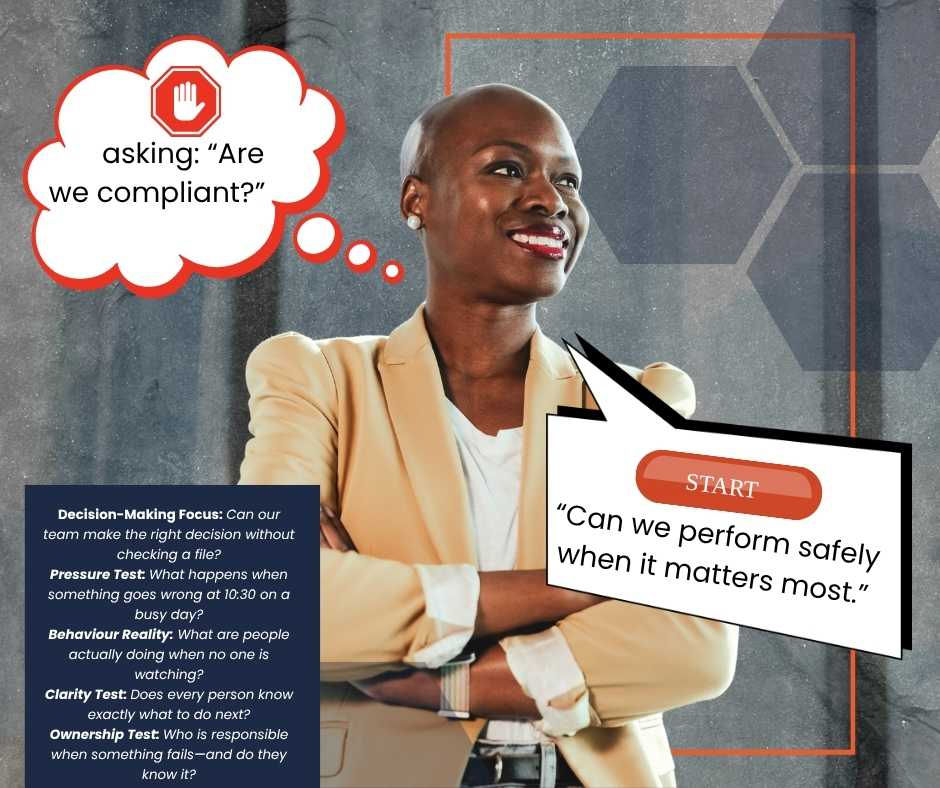
Stop asking: “Are we compliant?”
Start asking: "Can my team handle a real incident without hesitation?”
Download the OHS Acronyms Easy Reference Guide.
Then test your business:
Ask 3 people:
What’s the biggest risk in your area right now?
What do you do if something goes wrong?
Who is responsible for fixing it?
If they hesitate…
You don’t have a compliance problem.
You have a clarity problem.
Now ask yourself: “Is our system understood… or just documented?”
If you’re not confident in the answer,that’s exactly where RITE steps in.
We don’t just help you prepare for inspections. We help you build a system that works before they arrive.

Visit our shop for some OHS Goodies




Comments